Thursday, March 1, 2012

The Poll Pilgrimage of Senior Editors

By Raza Elahi

During the poll season, you must have read many columns and seen TV programmes based on the journalists' tour to the poll-bound areas. Each journalist do his/her reporting in individual capacity for the organisation he/she works. But very few know that for the last one and a half decade some of the country's best-known journalists and columnists (around 15-20) travel in a group to check the pulse of the voters and obviously to predict the people's verdict.
At the end of every trip, the group does a poll. The person whose prediction comes close to the actual results of the election is declared winner.

The group, which include Shekhar Gupta (editor-in-chief, The Indian Express),Arindam Sengupta (executive editor, The Times of India), Radhika and Prannoy Roy (NDTV founders), Columnists Swaminathan S Anklesaria Aiyar, Paranjoy Guha Thakurta and Surjit Bhalla, former Businessweek journalist Manjeet Kripalani, former BBC journalist Sanjeev Srivastava and psephologist Dorab Sopariwala etc, has covered every Lok Sabha poll and important assembly elections - 19 trips so far.

As per the wishes of the organisers, the tours and information about fellow-travellers rarely get mentioned in media. However, recently, a newspaper report carried some interesting experiences of these high-profile journalists when they went out together on poll pilgrimages, but the reporter's efforts to find out frequent winners among those high-profile journalists were not successful.
(elahi.raza82@gmail.com)

Wednesday, January 4, 2012

UP Muslims Should Think Before They Vote

By Raza Elahi

As all the parties are busy in wooing Muslim voters in Uttar Pradesh, it is time for the community to think and value the importance of their votes.

It is an irony that Muslim votes, which are around 16% in the state, get divided among the three main parties -- BSP, SP and Congress. There are just 55 Muslim MLAs in 403-seat UP assembly, despite the fact that Muslim votes play a major role in around 125 Assembly constituencies of which 80 seats have more than 20% of Muslim votes.

Although it is too early to predict the UP Assembly polls results, yet it is almost clear that there will be a hung Assembly. No party will likely to be in a position to form government on its own. As of now, two post-poll combinations are emerging and Muslims should also think in term of those combinations before they vote.

As Mayawati is losing ground -- courtesy scams, corruption charges and anti-incumbency factor -- she may not hesitate in joining hands with other parties after the result to remain in power. Congress and SP will certainly not go with BSP. This will leave Mayawati of no choice but to join hands with BJP. And the one likely post-poll combination is BSP-BJP combine with support of (if required) independents and other smaller parties.

SP, the other main party in the state, is leaving no stone unturned to encash all the anti-BSP plank with its strong party cadre. However, SP may also fall short of the magic figure.

The most interesting part of this Assembly poll is to see how Congress performs. Banking on Rahul Gandhi’s magic and his Muslim-Jat-Kurmi vote-bank innovation, Congress is certain to regain its lost glory, but again it also can't form the government on its own. In that case, the Congress will be more comfortable with SP rather than BSP in sharing the power in the state. It will also give Congress the support of SP MPs at the Centre. So, the second likely post-poll combination is Congress-RLD and SP combine with support of (if required) some fringe players.

Now, Muslim should vote in accordance with two things -- first, which of these two combinations suit them, and second how the number of Muslim MLAs can be increased.

It is clear that in most of the Muslim dominated constituencies there are at least two Muslim candidates fighting on the tickets of any of the four major parties -- BSP, SP, Congress-RLD and BJP. So, there are chances of their vote getting divided and wasted. Muslims should first think of which post-poll combinations will be better for the community. With BSP may go with BJP, Muslims should pick Congress-RLD and SP combine.

Now, the question is how Muslims should choose candidates between Congress-RLD and SP.

They should select candidates constituency-wise. Meaning, if any of these two parties (Congress-RLD and SP) has fielded Muslim candidates, then Muslim votes should go to Muslim candidates. If both the parties (Congress-RLD and SP) have given tickets to Muslim candidates in same constituency, then Muslims should pick any one of the two candidates and vote him/her en-bloc in that constituency. It is only then the number of Muslim MLAs can increase and the state can have a government which is better suited for the community.

(elahi.raza82@gmail.com)

Wednesday, July 27, 2011

Indian media going gaga over Hina

By Raza Elahi

Pakistan's new foreign minister Hina Rabbani Khar, who arrived in New Delhi on Tuesday amid hopes that the 34-year-old minister is not evidently aligned to the conservative mindset of her predecessors and might bring a refreshing change in diplomacy between the neighbours, has won many fans in India.

Though her political acumen is still untested as she navigates the troubled waters of the India-Pakistan relationship on her first major diplomatic outing, yet the female foreign minister has become talk of the town among Indian fans mainly because of her dress, smile and beauty.
It's not just the general public and twitterati, but the Indian media too, has gone gaga over Hina.

Look at the some of the flattering headlines of Indian newspapers on Wendnesday -- Pak Puts On Its Best Face (The Times of India); Pak bomb lands in India (Mumbai Mirror). Though most of the papers carried her photograph on the front page, The Pioneer carried a huge lead vertical picture on its front page. Economic Times's political page carried an info chart with her photo, saying Fresh face, Fresh start.
Hina made her fashion statement marked at the New Delhi airport itself when she landed in a monotone outfit of blue with delicately matched pearl jewellery, sunglasses and oversized Hermes Birkin bag.

As her talks with SM Krishna may not give our mediapersons to write much on diplomacy front, they certainly will continue to write more on Hina's style statement.

Tuesday, March 29, 2011

When two teams play, one wins and the other loses


By Raza Elahi

The much awaited India-Pakistan World Cup semi-final match in Mohali is set to begin today afternoon. For the last few days television channels and print publications of both the countries have covered every minutest details of 'what-will-happen' in the match in almost a warlike rhetoric.

The other day on an Indian news channels, two former cricketers Ravi Sashtri and Amir Sohail were almost trying to beat each other in totally biased opinions in favour of India and Pakistan respectively.

People on the street have attached the national pride and honour with this game and some have called it the mother of all clashes. They have gone crazy. They didn't mind buying Rs 250 tickets at a price above Rs 10,000 in the black market (in Mohali) a few days back.

Fans of both the teams want to see their team winning the game as this is the first match between the two countries since July 2008 which has taken place on the home soil of one of the teams.

Amid all this fever, the stage is also set for the cricket-diplomacy as two prime ministers will be watching the game. And, media is going extra mile to cover the politics behind the game.

However, somewhere between all these high-pitched noises, people as well as the media have perhaps forgotton the essence of the game. One should watch and appreciate the game and not the pre-defined winner. When two teams play, one wins and the other loses.

The two captains MS Dhoni and Shahid Afridi have made very balanced comments and people should watch the game and beyond in spirit of these comments of the two captains:

Shahid Afridi: "I hope that in the future, relations between India and Pakistan get better and stay better, whatever the results. There should be good cricket and people should enjoy the game."

M S Dhoni: “Somebody has to lose the game irrespective of what happens. It is a part and parcel of the sport. It doesn’t only happen in cricket — it happens in each and every sport”.


(elahi.raza82@gmail.com)

Monday, February 28, 2011

Cricket Chaat, courtesy TV news channels

By Raza Elahi
ICC World Cup 2011 is underway. The knives are out. The battle of supremacy is always in their minds. The motto is to outshine others. If your are thinking that I am talking about the teams participating in the ongoing cricket tournament, hold on. It is not about them but about Indian TV news channels scrambling for eyeballs during the Cup.
Every news channels seem to be in a race to outdo the other by getting an experts’ panel every day to talk about the nuances of the matches. They have special programmes titled, Big Toss and Kings of Cricket etc, as well as other talk shows that are trying their best to increase the adrenaline rush among the viewers.
There is no doubt that for about 1.2 billion people of the country cricket is not just a sport but something close to be called a religion. And that is why 24x7 news channels are in a rush to grab maximum eyeballs. But their extra effort most of the time turns boring. First, the anchors themselves become experts and try to speak most of the time than the experts and repeating the same thing again and again.

Then look at the experts who are not so expert popping up on every channels. Murli Karthik, Yograj Singh, Rohan Gavaskar, Aakash Chopra, Nikhil Chopra -- they all were certainly not good in their games at international level but are now leaving no stone unturned to give their viewpoints on TV. Though sometimes it is a delight to hear views of Geoffery Boycott, Imran Khan, Sunil Gavaskar, Ravi Sashtri, Allan Border, Zaheer Abbas and the likes appearing on different channels, it is just intolerable to sit and watch the Karthiks and Chopras.

But there is no prize for guessing why these channels have extended panels and programmes. The reason is simply not cricket. It is just the business and the market built around the cricketing action. All these hype and hoopla created by TV channels -- in the form of coverage, special programmes, discussions, contests and other off-the-field activities -- unnecessarily build pressure on Team India, a point which former Pakistan captain Imran Khan has also recently pointed out.

It will not be wrong to say that the excessive efforts of our news channels to present Cricket Chaat has become really chaat (boring).

Friday, January 28, 2011

Need for internal media ombudsman

By Raza Elahi
The recent observation of WikiLeaks founder Julian Assange about the good prospect of Indian media is an acknowledgment of great effort on part of Indian media, which has expanded by leaps and bounds over the years. According to a rough estimate, daily readership of newspapers in the country is over 200 million, which is a world record in terms of gross reach. Similarly, the reach of electronic media is envious when compared with other countries.However, some of the recent developments have also raised questions over the role of media -- whether it has been living up to the social responsibilities and promoting the democratic, secular and pluralist values.

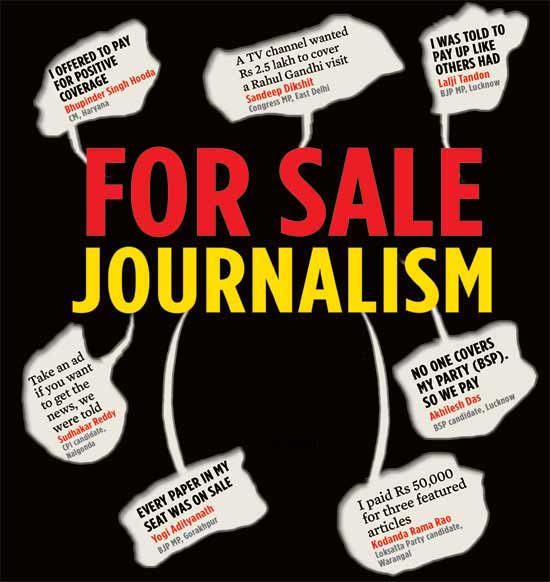
The Indian media has undoubtedly deviated from its objectives in the recent past. The trend like ‘paid news’ and the publication of the Niira Radia tapes on corporate-media nexus have made it important that media houses and media persons should make a self-critical assessment.

A few days back Chief Election Commissioner S Y Quraishi has also said ‘paid news’ during elections is one of its major challenges. The commission has been forced to intervene in the matter as the media has failed to regulate itself. The Election Commission had issued notices to 86 candidates with regard to ‘paid news’ during the Bihar election last year. Quraishi has conceded that the phenomenon of ‘paid news’ is very difficult to police.

According to the CEC, the problem of ‘paid news’ is best addressed by self-regulation by the media and political parties. But that is not happening.

The election commission is rightly concerned about the undue influence that ‘paid news’ can create on the minds of voters. The voters’ right to correct and unbiased information needs protection. There is a need for an internal news ombudsman in the press and the news channels in the country. The Radia tapes have widely compromised the independence and credibility of the media. The media houses need to put in place a code of practice.

It is also a high time for Editors Guild of India and Press Council of India to take more active role to check the phenomenon of ‘paid news’ and corporate-media nexus.
(The writer can be contacted at elahi.raza82@gmail.com)

Monday, January 3, 2011

When Tendulkar-centric Indian media surprises Kallis

By Raza Elahi

After South Africa’s convincing win against India in the first Test match at Centurion, Jacques Kallis must be certainly wondering about the strange bunch of television journalists, traveling with the Indian team.

Kallis, who scored a double century in the match, had never thought that he would have to answer some ‘weired queries’ of the Indian media. At a time when he was expecting questions about South Africa’s win or his own first Test double century, Kallis was amused by an Indian journalist who asked why he was not clapping after Sachin Tendulkar reached his historic landmark of 50th Test hundred.

Kallis, however, reminded him that while he was applauding, the television cameras were focused on Tendulkar and the Indian dressing room and he had perhaps stopped clapping by the time they returned their focus to the field. A South African journalist, who was shocked at how largely the Indian media were more interested in the cult of Tendulkar than what had happened on the field, reportedly could not stop himself in questioning an Indian TV reporter, “Did losing the game mean so little to you?”

“It doesn’t matter, our editor is more interested in Sachin’s 50th Test century,” came the response from the Indian TV reporter.
.
“You mean defeat by an innings, the biggest India have had in South Africa, means nothing?” the South African queried.

“We are interested only in the Sachin story today. Viewers are interested in that, not the team losing,” was the reply.

Taking a potshot at Indian media, columnist Trevor Chesterfield in his recent article has also written, “…there are as many as thirty-six television channels -- jostling for the best story, filing a snippet from the team’s practice, a day’s play or post-match conference -- has a habit of descending into a mad, often frenzied scramble for bytes.

Chesterfield, too, couldn’t digest Tendulkar-centric reporting by Indian media despite the fact that India lost the match by an innings and twenty-five runs when he wrote, “As with any good government propaganda, the Tendulkar century was used as a ploy by the television networks to cover the team’s embarrassing defeat.”

Undoubtedly, Sachin’s 50th Test century was a golden moment of the cricket history but such pity questions like “who clapped or who jumped on the occasion” show the habit of a section of media -- particularly electronic media -- of going overboard over anything.

(The writer can be contacted at elahi.raza82@gmail.com)