Monday, February 28, 2011

Cricket Chaat, courtesy TV news channels

By Raza Elahi
ICC World Cup 2011 is underway. The knives are out. The battle of supremacy is always in their minds. The motto is to outshine others. If your are thinking that I am talking about the teams participating in the ongoing cricket tournament, hold on. It is not about them but about Indian TV news channels scrambling for eyeballs during the Cup.
Every news channels seem to be in a race to outdo the other by getting an experts’ panel every day to talk about the nuances of the matches. They have special programmes titled, Big Toss and Kings of Cricket etc, as well as other talk shows that are trying their best to increase the adrenaline rush among the viewers.
There is no doubt that for about 1.2 billion people of the country cricket is not just a sport but something close to be called a religion. And that is why 24x7 news channels are in a rush to grab maximum eyeballs. But their extra effort most of the time turns boring. First, the anchors themselves become experts and try to speak most of the time than the experts and repeating the same thing again and again.

Then look at the experts who are not so expert popping up on every channels. Murli Karthik, Yograj Singh, Rohan Gavaskar, Aakash Chopra, Nikhil Chopra -- they all were certainly not good in their games at international level but are now leaving no stone unturned to give their viewpoints on TV. Though sometimes it is a delight to hear views of Geoffery Boycott, Imran Khan, Sunil Gavaskar, Ravi Sashtri, Allan Border, Zaheer Abbas and the likes appearing on different channels, it is just intolerable to sit and watch the Karthiks and Chopras.

But there is no prize for guessing why these channels have extended panels and programmes. The reason is simply not cricket. It is just the business and the market built around the cricketing action. All these hype and hoopla created by TV channels -- in the form of coverage, special programmes, discussions, contests and other off-the-field activities -- unnecessarily build pressure on Team India, a point which former Pakistan captain Imran Khan has also recently pointed out.

It will not be wrong to say that the excessive efforts of our news channels to present Cricket Chaat has become really chaat (boring).

Friday, January 28, 2011

Need for internal media ombudsman

By Raza Elahi
The recent observation of WikiLeaks founder Julian Assange about the good prospect of Indian media is an acknowledgment of great effort on part of Indian media, which has expanded by leaps and bounds over the years. According to a rough estimate, daily readership of newspapers in the country is over 200 million, which is a world record in terms of gross reach. Similarly, the reach of electronic media is envious when compared with other countries.However, some of the recent developments have also raised questions over the role of media -- whether it has been living up to the social responsibilities and promoting the democratic, secular and pluralist values.

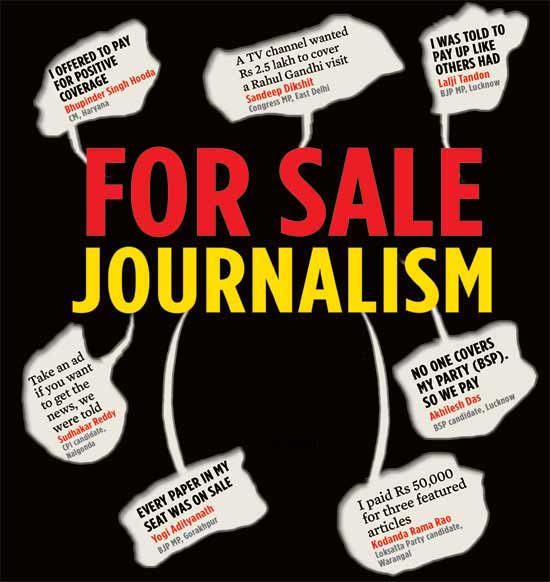
The Indian media has undoubtedly deviated from its objectives in the recent past. The trend like ‘paid news’ and the publication of the Niira Radia tapes on corporate-media nexus have made it important that media houses and media persons should make a self-critical assessment.

A few days back Chief Election Commissioner S Y Quraishi has also said ‘paid news’ during elections is one of its major challenges. The commission has been forced to intervene in the matter as the media has failed to regulate itself. The Election Commission had issued notices to 86 candidates with regard to ‘paid news’ during the Bihar election last year. Quraishi has conceded that the phenomenon of ‘paid news’ is very difficult to police.

According to the CEC, the problem of ‘paid news’ is best addressed by self-regulation by the media and political parties. But that is not happening.

The election commission is rightly concerned about the undue influence that ‘paid news’ can create on the minds of voters. The voters’ right to correct and unbiased information needs protection. There is a need for an internal news ombudsman in the press and the news channels in the country. The Radia tapes have widely compromised the independence and credibility of the media. The media houses need to put in place a code of practice.

It is also a high time for Editors Guild of India and Press Council of India to take more active role to check the phenomenon of ‘paid news’ and corporate-media nexus.
(The writer can be contacted at elahi.raza82@gmail.com)

Monday, January 3, 2011

When Tendulkar-centric Indian media surprises Kallis

By Raza Elahi

After South Africa’s convincing win against India in the first Test match at Centurion, Jacques Kallis must be certainly wondering about the strange bunch of television journalists, traveling with the Indian team.

Kallis, who scored a double century in the match, had never thought that he would have to answer some ‘weired queries’ of the Indian media. At a time when he was expecting questions about South Africa’s win or his own first Test double century, Kallis was amused by an Indian journalist who asked why he was not clapping after Sachin Tendulkar reached his historic landmark of 50th Test hundred.

Kallis, however, reminded him that while he was applauding, the television cameras were focused on Tendulkar and the Indian dressing room and he had perhaps stopped clapping by the time they returned their focus to the field. A South African journalist, who was shocked at how largely the Indian media were more interested in the cult of Tendulkar than what had happened on the field, reportedly could not stop himself in questioning an Indian TV reporter, “Did losing the game mean so little to you?”

“It doesn’t matter, our editor is more interested in Sachin’s 50th Test century,” came the response from the Indian TV reporter.
.
“You mean defeat by an innings, the biggest India have had in South Africa, means nothing?” the South African queried.

“We are interested only in the Sachin story today. Viewers are interested in that, not the team losing,” was the reply.

Taking a potshot at Indian media, columnist Trevor Chesterfield in his recent article has also written, “…there are as many as thirty-six television channels -- jostling for the best story, filing a snippet from the team’s practice, a day’s play or post-match conference -- has a habit of descending into a mad, often frenzied scramble for bytes.

Chesterfield, too, couldn’t digest Tendulkar-centric reporting by Indian media despite the fact that India lost the match by an innings and twenty-five runs when he wrote, “As with any good government propaganda, the Tendulkar century was used as a ploy by the television networks to cover the team’s embarrassing defeat.”

Undoubtedly, Sachin’s 50th Test century was a golden moment of the cricket history but such pity questions like “who clapped or who jumped on the occasion” show the habit of a section of media -- particularly electronic media -- of going overboard over anything.

(The writer can be contacted at elahi.raza82@gmail.com)

Tuesday, December 28, 2010

Beware, journalists… sorry bloggers will report

By Raza Elahi

"News is something someone wants suppressed. Everything else is just advertising”.
British press magnate Lord Northcliffe


In a season when the leaked conversations between corporate lobbyist Niira Radia and some of India’s top journalists continue to evoke public curiosity and the WikiLeaks’ disclosure of internal communications between US diplomats based outside America and the central command at Washington embarrassing the White House, one may not be wrong in saying that technology alone can take on the task of bringing out something which someone wants to suppress.

Although much of the mainstream media -- except Open and Outlook magazines -- initially blacked out Radia tapes, yet they reached the public through the networking sites, blogs and Twitter etc.

Similarly, an unfazed and defiant Julian Assange, the founder of whistleblower website WikiLeaks, has exposed the secrets of America that many US government officials contend those information should not be made public because it will endanger many lives.

In traditional newspapers and news channels -- which are mostly controlled and managed by corporate houses -- journalists have to follow certain protocols or guidelines in deciding what stories/feed to cover and what to ignore, but today, technology has changed it all. Now, any individual can build his own website/portal/blog by using the Internet and if he knows how to gather information and report it to the public, he can serve it as an independent source of news and opinion.

Today, bloggers (the new crop of ‘journalists’) are fearlessly exposing corruption and acting as whistleblowers. They are individuals, having no burden of being affiliated to corporate houses, express and exchange their views through blogs and internet groups.

The example of WikiLeaks and the emerging trend of blogging, social networking and tweeting have definitely changed the rule of disseminating information.

(The writer can be contacted at elahi.raza82@gmail.com)

Thursday, August 12, 2010

Southpaws summon for the rightminded

By Raza Elahi

What is common among former US presidents Gerald Ford, George Bush Sr, Bill Clinton and Barack Obama? To tease you further Paul McCartney, Prince Charles, Queen Victoria and Oprah Winfrey also belong to the same common club.

If you have thought the answer “they are all left-handed”, right on. These famous men and women are among the thousands of left-handers who have left their mark on the world.

Tomorrow (August 13) is International Left-Handers’ Day, a day meant to promote awareness of the inconveniences facing left-handers in a predominantly right-handed world. There are some left-hander handicaps like guitar, violin, camera, sewing machine, scissors and classroom chairs etc.

But southpaws, who form 10 percent of the world's population, have made a strong case for being smarter, showing more leadership qualities and intelligence than the vast right-handed majority. According to experts, the right side of the brain is more capable of multi-tasking. Left-handed people use the right side of their brain, which means ‘lefties’ are thought to be good at music, art, creativity, perception, emotions, genius, and even sports, in what is known as the holistic thinking mode.

Dr Alan Searleman, from St Lawrence University in New York, has gathered evidence on the link between left-handedness and intellectual creativity and has discovered that they have a higher ‘fluid intelligence, a better vocabulary and are better at problem-solving.

The left-handers form an exclusive club. Some of the big names of history, politics, literature and entertainment are left-handers – Julias Ceaser, Pabalo Picasso, Leonardo Da Vinci, Benjamin Franklin, Lewis Carroll, Mark Twain, HG Wells, Charlie Chaplin, Bob Daylan, Alexander the Great, Napolean Bonaparte, Fidel Castro, Queen Victoria, Thomas Edison, Paul McCartney and many more, including our very own Amitabh Bachchan.

Many people may not know that the US has had five left-handed presidents since 1974 –Gerald Ford, Ronald Regan, George H W Bush, Bill Clinton and Barack Obama. The high ratio of left-handers who climb to the top of the US political ladder is all the more baffling, when one considers that only 10-12% of Americans write with their left hands. Even the ranks of vice-presidents or unsuccessful contenders for the White House are heavy with left-handers. John McCain, Al Gore, Bob Dole, John Edwards and Ross Perot were all lefties.

It is certainly not a left-handed compliment!

(The writer, who is also a left-hander, can be contacted at elahi.raza82@gmail.com)

Friday, July 30, 2010

Brishti pore tapur tupur

By Raza Elahi

After hot and humid summer when monsoon sets in, it brings back relief, joy and cheers around the corner. In India, everybody has his own style to enjoy the rainy season. Succulent jamuns, irresistible bhuttas, garma garam chai and pokaras are inseparable part of the monsoon and so is the romance with poetry during the season.

Whether it is Bangla lori Brishti pore tapur tupur; node elo baan,baaner jole bhaslo pukur, bhaslo golar dhaan or Hindi movie song Rim jhim ke tarane leke aayi barsaat, rain and poetry always move hand-in-hand.

Famous poet Mirza Ghalib often sought to give up drinks, but like an intelligent man he made exceptions when he said:
Ghalib chhuti sharab, par ab bhi kabhi kabhi
Peeta hoon roz-e-abr shab-e-mahtaab mein


(Ghalib, I gave up drink but even now sometimes I drink on a cloudy day and on moonlit night)

Another Urdu poet Faiz was not far behind when he said:
Aaye kuch abr, kuch sharaab aye
Uske baad aaye jo azaab aaye


(Let there be some clouds, and let wine come. After that let any disaster come).

Kalidas visualized monsoon clouds as messengers who carried affection and desire to and fro between separated lovers. And years later, Majrooh Sultanpuri described the same feeling of separated lovers when he penned lyrics for movie “Dharti Kahe Pukaar ke”:

Jaa re kare badra balam ke pass,
woh hain aise buddhu ke samjhe na payaas


Rain songs are always been there in Hindi cinema. While lyricist Yogesh wrote rim jhim gire sawaan for film “Manzil”, Jawed Akhtar penned rimjhim, rum-jhum, rum-jhum, Bheegi bheegi rut mein, tum-hum, hum tum … for “1942: A Love Story.”

There are quite a few directors in the Bollywood who have captured the mood of monsoon through beautiful lyrics and superb music. Songs like Barsaat main hum se mile tum; zindagi bhar nahin bhoolenge woh barsaat ki raat; Payaar hua iqrar hua and the title song of aaya sawan jhum ke are a few among others which signify monsoon as a season of celebration and joy.

However, for some rain is a time for remeberance and despair as far as this couplet of a poet is concerned:

Yun barastain hain tasauvvar pe purani yaadein
Jaise barsaat main rim jhim ka samna hota hai


(Old memories fall on the surface of my mind, like raindrops in monsoon)

But, the mood really becomes sombre if one hears Mohmmad Rafi’s
Sawaan ke mahine mein,
ek aag si seeney mein lagti hai to pee leta hoon,
do char ghari jee leta hoon
.

(elahi.raza82@gmail.com)

Monday, July 5, 2010

Can India afford to ignore Islamic banking?

By Raza Elahi
The recent statement of MS Swaminathan, the father of green revolution in India, that Islamic banking can be a solution for farmers’ suicide in Vidarbha is apt reply to those opposing it tooth and nail by terming this banking system as anti-economic growth.

It is truth, nothing but truth, that exorbitant lending rates charged by moneylenders have created a vicious cycle of debt and suicide not only in Vidarbha, but also in several parts of the country. Islamic banking, which propagates zero-interest lending, can solve not only farmers’ suicide crisis but will also fill the gap between financially-excluded and financially-included classes of the country.

In 2008, Raghuram Rajan Committee recommended interest-free banking in the country to encourage financial inclusion, but nothing much has been done in this direction. The initiative taken by the Kerala government in this regard is sub judice.

The financially-excluded class, which includes small farmers, landless labourers, self-employed, minorities and women, forms around 60% of the country’s population. They do not have access to formal banking. They find it difficult to meet the demand of pre-determined interest rates. If finance is available without the burden caused by pre-determined interest rates, it will be a far-reaching implication for the socio-economic and educational uplift of the masses.

The main objective of Islamic finance is to create a society of investors, unlike the conventional banking system, which has made and created the society of borrowers and lenders from the past 800 years. Islamic banking regards the public interest above all other motives. According to the Islamic banking concept, the banks involve themselves in real time trading or investment activities with their customers based on various contracts like Mudarabah (partnership), Musharaka (joint venture), Murabaha (cost-plus), Ijara (leasing) and some hybrids combining two contracts (Musharaka Mutanaqisa) etc, and therefore earn profit. All the products that these banks offer are Sharia-compliant. A Sharia board decides or monitors what sort of investments the banks can make.

Furthermore, Islamic banking in India will not only be beneficial for the marginalised and the minorities in terms of microfinance, but can also attract major investment from the Gulf countries. The UK and France have made necessary regulatory changes in order to attract these investments.

Islamic banking industry, which is operating for the past 30 years in the Middle Eastern countries, has gained popularity and curiosity around the globe during the financial crisis of 2008. Despite the financial turmoil that crippled so many large Western institutions, Islamic banks continued to grow in prominence and size.

According to a survey conducted by The Asian Banker, a Singapore-based publication last year, the combined assets of world’s 100 top Islamic banks increased 66% in 2008, bucking the trend of slow growth in other markets. Asia’s 300 largest banks, for example, only grew assets 13.4% in the same period. Now, many financial experts are seeing Islamic banking as an alternative to the conventional banking system, which is based on stronger regulatory regimes and a better international understanding of its dynamics.

It is a misconception that Islamic finance is just a Muslim-only affair. For all the Shariah-compliant products sold in countries such as Malaysia, around 40% of clients are non-Muslims. Around 20% customers of Islamic banks in Britain are non-Muslims. Manfred Dirrheimer, chairman of the executive board, FWU AG, a German financial services company, recently told Arab News, “For all the Shariah-compliant products we sell in countries such as Malaysia, some 70% of our clients are non-Muslim."

In India, SEBI has permitted Shariah-compliant financial products such as mutual funds, but still many steps, including necessary banking regulatory changes, are required to establish full-fledge Islamic banking in the country. The delay, it seems, is a bit longer. When London, Tokya Singapore and Hong Kong could become hub and house of Islamic finance, then why not Delhi, Mumbai, Chennai or Cochin?